
The Hardest Part of Being a Bay Area Magician Is Not the Magic


When people hear there is a magician at their company party, they picture the tricks. Cards, coins, something vanishing.
But the tricks are honestly the smallest part of the job.
I tell clients this all the time. There are plenty of amazing talented magicians out there. That is not the problem. The hardest thing is finding somebody who is not only entertaining but also knows how to read a room, and knows when to approach people and when not to. That right there is the real deal breaker.
I perform at over 100 events a year, and after enough rooms across the Bay Area, that is the skill I would tell you to hire for.
What a Bay Area Magician Does Before the First Trick
A Bay Area magician who is any good is working before the doors open.
I always arrive before the guests, which gives me time to learn the layout of the room. My first goal is to connect with my client or day of contact, confirm everything is still the same, and ask about any changes to the run of show. Things move around on event day constantly, and the last thing you want is your entertainer working off a plan from three weeks ago.
That is also why I require a consultation call before every event. If I know the flow in advance, I can move the magic to a different space or time so nothing clashes with a DJ, a speech, or dinner service.
How Do You Decide Which Group to Walk Up To?

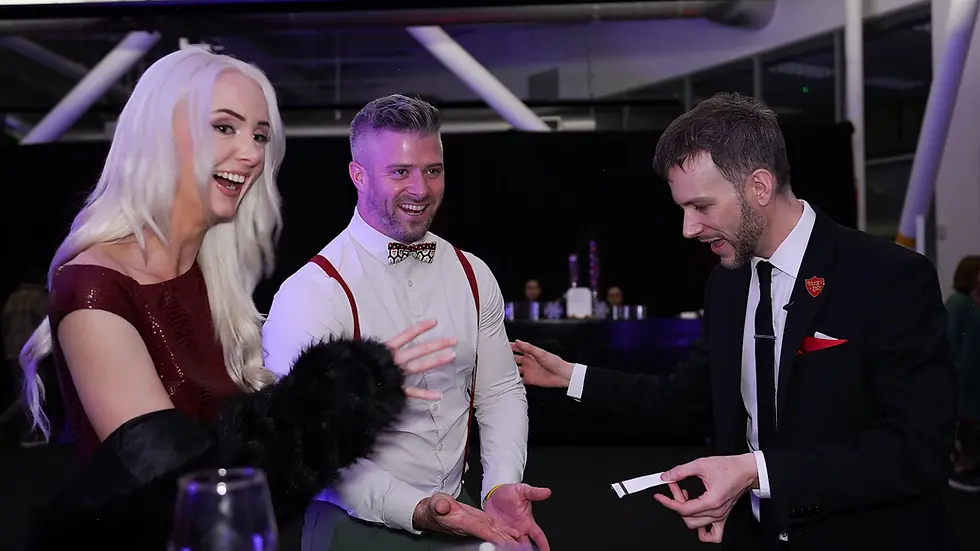
When I first walk out into a party, my first thing is to approach a group as quickly as possible. I want to get the magic started, and I want the energy going right away!
As a warm up I like to pick a lively group. That is a great place to start, with people already having a good time.
From there I select groups based on body language, based on who is eating and who isn't. There are a lot of social cues I use to decide who to approach and when.
I typically won't walk up and say, hey, pick a card. That can be jarring, and sometimes actually a bit rude. If you are going to politely interrupt a conversation, you introduce yourself first. I usually say something like, hey, how's everyone doing over here? This seems like a fun group.
Then I introduce myself as the magician at the party, so now they know why I am there. That is usually the moment they get pretty excited, and I can start performing!
Knowing When to Leave People Alone
This is the half of the job nobody talks about.
I worked a conference happy hour for seven hundred guests, and the first hour was slow. People were still finishing sessions and talks, and since it was a developer conference, I was looking at a sea of laptops. I had to be selective about who I approached so I was not interrupting real work or networking.
Sometimes I will hold off on a group until the very end of the evening, because I could tell they weren't ready. Deep in conversation, or body language telling me they wanted to be left alone. It is still my job to offer the magic, so I will come up and, through body language and tone of voice, convey that I know they are busy. Something like, hey, I am about to head out, did you want to see a quick trick?
Usually my read is correct and they will say thank you for asking, but no. What I find is they appreciate being asked, and that I read the situation. Nobody's feelings are hurt, and I think they like that I am respecting their time. Turns out the research says the same thing about team building. It only works when people can actually opt out.
What Clients Say
"Spencer did walking magic for our corporate post-conference happy hour and it was the highlight of the evening! He perfectly read the room and everyone present had glowing reviews. His performance ensured the event was filled with laughter and people were having a great time!"
- Lydia, MongoDB
"Your ability to connect with our attendees was truly impressive!"
- Sheena, Meta
Every Room in the Bay Area Has a Different Temperature
A black tie banquet is not a conference happy hour, and neither one is a 400 person end of year party.
At a formal event everyone is dressed up and it is a little more of an official evening. When things feel too official, people hold back, and that is the exact opposite of what you want at a party. At a conference, half the room came from different companies and nobody knows each other yet. At a holiday party it is all fun and laughing and nobody is thinking about work.
The crowds are different too. There is a real difference between an engineering group and a sales organization, because different skills tend to attract different personalities.
Good news for my clients here. My dad was an engineer. As a teenager learning magic I tested everything on him, and he was never going to give me a big freak out reaction. He would sit there and puzzle at it. So I got very good at creating magic for that type of audience, which is a lot of what a Bay Area magician ends up doing.
Engineers tend to be more reserved and intellectual problem solvers, so with them it is about showing really cool puzzles and watching them try to decode it. A sales organization is usually more outgoing, big personalities, so there is a lot more comedy and improv. Honestly it is a blast!
Neither one is better. Everybody expresses joy differently, and somebody being reserved instead of laughing out loud does not mean they are enjoying it less.
What This Actually Means When You Hire Someone
Whether it is 100 people or 10,000 people, there is always an energy in the space, and a well seasoned performer who has their 10,000 hours can feel that and act accordingly. I think that is the real power of a great performer.
So when you are comparing one Bay Area magician against another, the demo reel will tell you whether the tricks are good. It will not tell you whether the person can walk into your room and know what to do with it.
Ask about that on the call instead. Ask how they decide who to approach, what they do when a guest says no, and what they would change about your run of show. The answers will tell you plenty.
Common Questions About Booking a Bay Area Magician
How do I know if a magician can actually read a room?
Ask them to walk you through a past event that did not go to plan. Anyone who works a lot of rooms has one, and how they describe the adjustment tells you almost everything.
Should I tell the magician which groups to visit?
I would let them decide. Oftentimes a host is excited and wants to direct the performer toward certain groups, and I encourage clients to lean on the professional instead. Do tell them about anyone who should be prioritized, like a VIP client or a guest of honor.
What if some of my guests do not want to participate?
I never force it. If somebody says no, I take that at face value and move to the person next to them without missing a beat. The rate of people declining is very, very low, and the group glosses over it so fast that we never lose momentum.
Will everyone at my event see the magic?
At a large event, honestly no. Not everyone gets to the photo booth or tries every item on the buffet either. What matters is that enough of the room experiences it that the reactions spread.
Final Thoughts
The tricks matter, of course. I have spent my whole life on them.
But when you hire a Bay Area magician, what you are really buying is the ability to read a room full of strangers and give each of them the right experience at the right moment. Some of my favorite moments are the guests who would not have engaged with anything else all night. The ones who might have grabbed a drink and quietly left early. Reaching those people is the whole job!
If you are planning something in the Bay Area and you are wondering whether magic would work for it, reach out through my contact form and ask. I will tell you honestly what I think, and if it is a fit, we will figure out where the magic belongs.


Comments